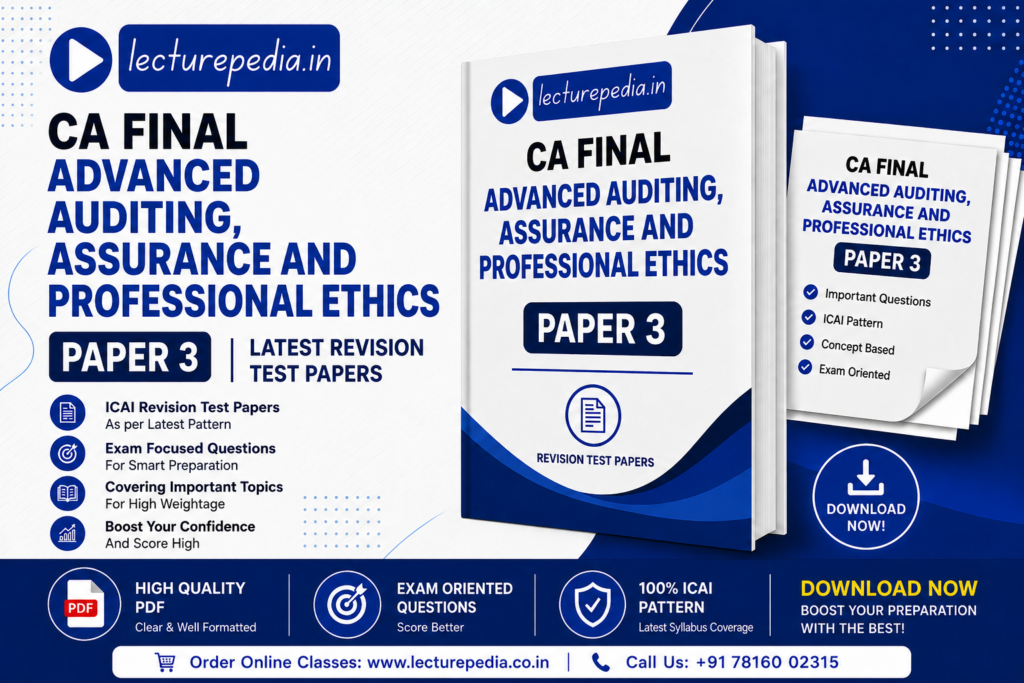

A structured revision guide covering the Code of Ethics, Fundamental Principles, Independence Threats, NOCLAR, Schedules of Professional Misconduct, Disciplinary Mechanism and important Council Guidelines.
Introduction to Professional Ethics
Professional Ethics is an important area of CA Final Audit preparation. It deals with the ethical responsibilities, professional conduct and standards expected from Chartered Accountants.
For effective revision, students should understand the Fundamental Principles first and then connect them with independence requirements, professional misconduct, Council Guidelines and disciplinary provisions.
1. Overview & Structure of Code of Ethics
The ICAI Code of Ethics lays down professional standards applicable to Chartered Accountants in India. The framework contains different parts dealing with professional conduct, Chartered Accountants in service and practice, and independence requirements.
| Section | Applicability | Scope & Key Principle |
|---|---|---|
| Part 1 | All Chartered Accountants | Fundamental principles and requirements of the Code. |
| Part 2 | CA in Service | Provisions applicable to members working in employment. |
| Part 3 | CA in Practice | Provisions applicable to professional practice. |
| Part 4A | Audit / Review | Independence requirements applicable to audit and review engagements. |
| Part 4B | Other Assurance Engagements | Independence requirements for applicable assurance engagements. |
2. Fundamental Principles
IOCP² — Integrity, Objectivity, Confidentiality, Professional Competence & Due Care, Professional Behavior.
Integrity
Integrity requires a Chartered Accountant to be straightforward, honest and truthful in professional and business relationships.
Objectivity
Objectivity requires professional judgment to remain free from bias, conflict of interest and undue influence.
Confidentiality
A professional accountant is required to respect the confidentiality of information acquired during professional and business relationships.
Professional Competence & Due Care
A Chartered Accountant should maintain professional knowledge and skill at the required level and act diligently in accordance with applicable technical and professional standards.
Professional Behavior
Professional behavior requires compliance with relevant laws and regulations and avoidance of conduct that may discredit the profession.
3. Five Independence Threats
Students should remember the five commonly discussed threats to compliance with the fundamental principle of objectivity and independence:
- Self-Interest Threat
- Self-Review Threat
- Advocacy Threat
- Familiarity Threat
- Intimidation Threat
Where threats are identified, appropriate safeguards should be considered in accordance with the applicable framework.
4. NOCLAR — Non-Compliance with Laws and Regulations
NOCLAR deals with professional responsibilities when a professional accountant becomes aware of non-compliance with laws and regulations.
| Attribute | CA in Practice | CA in Service |
|---|---|---|
| Applicability | Applies in accordance with the prescribed NOCLAR framework and applicable circumstances. | Applies to professional accountants in employment in the circumstances covered by the framework. |
| Professional Response | Requires appropriate consideration, communication and action in accordance with applicable requirements. | Requires appropriate escalation and consideration of further action where applicable. |
5. ICAI Disciplinary Mechanism
The disciplinary mechanism is an important area for Professional Ethics revision. Students should understand the distinction between the First Schedule and Second Schedule and the authorities dealing with disciplinary matters.
- Disciplinary Directorate: Handles the preliminary stages of disciplinary proceedings as prescribed.
- Board of Discipline: Deals with matters falling within its prescribed jurisdiction, including matters under the First Schedule.
- Disciplinary Committee: Deals with matters falling within its prescribed jurisdiction, including matters under the Second Schedule.
- Appellate Authority: Provides the applicable appellate mechanism against disciplinary orders.
6. Schedule 1 – Professional Misconduct
Naughty Friends Prefer Pizza, But Smart Auditor Prefers A Pure Business Signature
Relates to allowing non-members or unauthorized persons to practise in one's name.
Relates to sharing fees or profits with persons where such sharing is not permitted.
Relates to accepting a share of profits or commissions from professional engagements where such acceptance is not permitted.
Relates to entering into partnerships that are not permitted under the applicable professional rules.
Relates to securing professional business through channels not open to Chartered Accountants.
Relates to solicitation of professional work through prohibited methods, subject to applicable permissions and exceptions.
Relates to advertising professional attainments or services and the use of designations in circumstances where such use is not permitted.
Relates to accepting an audit position without making the required communication with the previous auditor.
Relates to accepting audit appointments without complying with applicable appointment requirements.
Relates to charging fees based on percentage or contingency arrangements except where specifically permitted.
Relates to engaging in another business or occupation where the applicable professional permission has not been obtained.
Relates to permitting unauthorized persons to sign balance sheets, reports or other documents requiring professional authentication.
7. Schedule 2 – Professional Misconduct
Confidential Examination Report Contains Future Earnings Opinion
- Clause 1: Matters relating to unauthorized disclosure of client information.
- Clause 2: Matters relating to certification or examination without appropriate verification.
- Clause 3: Matters relating to future earnings forecasts.
- Clause 4: Matters involving opinions where the applicable interest restrictions arise.
- Clause 5 & 6: Matters relating to material facts and material misstatements.
- Clause 7: Gross negligence or failure to exercise due diligence.
- Clause 8: Failure to obtain sufficient appropriate audit evidence.
- Clause 9: Material departure from generally accepted auditing procedures.
- Clause 10: Matters relating to handling and deposit of client money.
8. Important Council Guidelines
Tax Audit Limits
Students should revise the applicable tax audit ceiling, restrictions on sharing or pooling limits and the relevant exceptions.
Statutory Audit Limits
Revise the applicable statutory restrictions on the number of company audits that may be undertaken.
Indebtedness
The prescribed limits relating to indebtedness and guarantees should be memorised along with their applicability.
Network Guidelines
Revise the rules relating to network formation, naming, registration and applicable fee restrictions.
Branch Office
Remember the applicable requirements relating to the member in charge of a branch office and the relevant exceptions.
9. Quick Revision Checklist
- Fundamental Principles
- Confidentiality
- Five Independence Threats
- NOCLAR
- First Schedule
- Second Schedule
- Disciplinary Mechanism
- Council Guidelines
- Important Professional Limits
Related CA Final Resources
- CA Final Courses
- CA Free Resources
- CA Previous Year Papers
- CA Practice Papers
- CA Last Minute Preparation
CA Final Audit Revision
For quick revision, you can also refer to the CA Final Audit Summary Chart Book and the Professional Ethics revision class by CA Balakrishna Kovuru.
Watch Revision Class View Chart Book